
Ashok Kumar
EV Technology Specialist | 6 min read
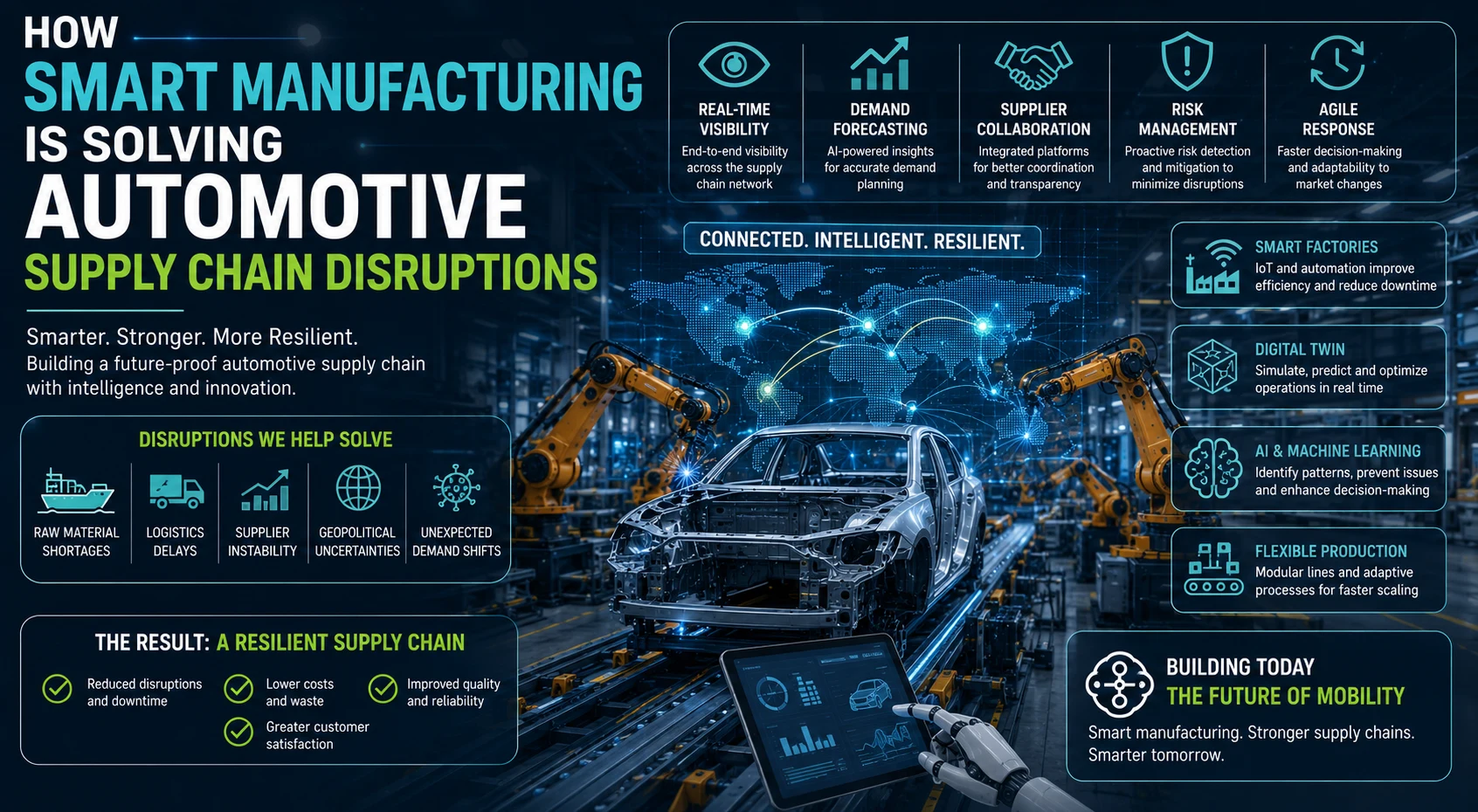
The automotive industry has always relied on a highly interconnected global supply chain. From raw materials and semiconductors to batteries and vehicle components, manufacturers depend on thousands of suppliers working together seamlessly. However, recent years have exposed significant vulnerabilities in automotive supply chains. Global events, transportation bottlenecks, semiconductor shortages, rising material costs, and geopolitical uncertainties have disrupted production schedules and delayed vehicle deliveries worldwide.
As the industry embraces electric mobility, connected vehicles, and advanced manufacturing technologies, companies are turning to smart manufacturing to build more resilient and agile supply chains. By leveraging technologies such as Artificial Intelligence (AI), Industrial Internet of Things (IIoT), automation, predictive analytics, and digital twins, automotive manufacturers can identify risks earlier, improve visibility, and respond more effectively to disruptions.
The growing importance of smart manufacturing solutions has become a key discussion point at leading industry platforms such as EV Expo India, where manufacturers, technology providers, and mobility leaders explore innovations shaping the future of automotive production and supply chain management.
Understanding Automotive Supply Chain Disruptions
Automotive supply chains are among the most complex in the world. A single vehicle may contain thousands of parts sourced from multiple countries and suppliers. Any disruption in one segment can impact the entire production process.
Some of the most common challenges include:
Semiconductor shortages
Delays in raw material availability
Transportation and logistics bottlenecks
Rising fuel and freight costs
Labor shortages
Inventory management issues
Demand forecasting inaccuracies
Traditional supply chain systems often struggle to adapt quickly to sudden changes, leading to production delays, increased costs, and reduced customer satisfaction.
This is where smart manufacturing is making a significant difference.
What Is Smart Manufacturing?
Smart manufacturing refers to the integration of advanced digital technologies into production and supply chain operations. It creates connected ecosystems where machines, systems, suppliers, and decision-makers communicate in real time.
Key technologies involved include:
Artificial Intelligence (AI)
Machine Learning
Industrial Internet of Things (IIoT)
Robotics and Automation
Cloud Computing
Digital Twins
Predictive Analytics
Advanced Data Management Systems
These technologies enable manufacturers to make faster, more informed decisions while improving overall operational efficiency.
Real-Time Supply Chain Visibility
One of the biggest advantages of smart manufacturing is enhanced visibility across the supply chain.
Traditionally, manufacturers often faced delays in identifying supply shortages or transportation issues. Smart manufacturing systems provide real-time monitoring of inventory levels, supplier performance, shipment tracking, and production status.
Benefits include:
Faster issue detection
Improved inventory planning
Better supplier coordination
Reduced production delays
Enhanced operational transparency
Real-time visibility allows manufacturers to proactively address challenges before they escalate into major disruptions.
AI-Powered Demand Forecasting
Accurate demand forecasting is essential for maintaining supply chain stability.
Artificial Intelligence can analyze vast amounts of historical data, market trends, customer behavior, and economic indicators to predict future demand more accurately than traditional forecasting methods.
AI-driven forecasting helps manufacturers:
Optimize inventory levels
Reduce excess stock
Prevent material shortages
Improve production planning
Increase responsiveness to market changes
As showcased at AutoTech Asia, AI-powered forecasting tools are becoming increasingly important for automotive manufacturers navigating an unpredictable global market.
Predictive Analytics for Risk Management
Supply chain disruptions often occur unexpectedly, making proactive risk management essential.
Predictive analytics uses data modeling and machine learning to identify potential risks before they impact operations.
Examples include:
Supplier performance issues
Equipment failures
Logistics delays
Inventory shortages
Demand fluctuations
By predicting disruptions in advance, manufacturers can develop contingency plans and minimize operational impact.
This proactive approach significantly improves supply chain resilience and business continuity.
Industrial IoT Enhancing Supply Chain Connectivity
Industrial Internet of Things (IIoT) technology connects machines, sensors, warehouses, suppliers, and logistics systems into a single digital network.
IIoT devices continuously collect and transmit data related to:
Production status
Equipment performance
Inventory movement
Shipping conditions
Warehouse operations
This interconnected environment enables manufacturers to make real-time decisions based on accurate and up-to-date information.
IIoT also improves collaboration between suppliers and manufacturers, ensuring better coordination throughout the supply chain.
Digital Twins Revolutionizing Supply Chain Planning
Digital twin technology is rapidly gaining traction in the automotive industry.
A digital twin is a virtual representation of a physical asset, production line, or supply chain network. Manufacturers can use digital twins to simulate various scenarios and evaluate potential outcomes before implementing changes.
Applications include:
Supply chain optimization
Production scheduling
Inventory management
Risk assessment
Logistics planning
Digital twins help manufacturers identify bottlenecks, test alternative strategies, and improve overall supply chain efficiency.
These innovations are frequently highlighted at EV Expo India, where industry experts discuss how digital transformation is reshaping automotive operations.
Automation Improving Production Flexibility
Modern automotive factories are increasingly relying on automation to improve efficiency and reduce dependency on manual processes.
Advanced robotic systems can quickly adapt to changing production requirements, helping manufacturers respond more effectively to supply chain disruptions.
Automation benefits include:
Faster production adjustments
Reduced labor dependency
Improved quality consistency
Increased productivity
Enhanced operational flexibility
Flexible manufacturing systems allow companies to shift production priorities when component shortages or market changes occur.
Smart Inventory Management
Maintaining the right inventory balance is crucial for supply chain stability.
Too much inventory increases storage costs, while insufficient inventory can halt production.
Smart inventory management systems use AI and real-time analytics to optimize stock levels based on demand forecasts and supplier performance.
Advantages include:
Reduced carrying costs
Lower waste levels
Improved material availability
Faster replenishment cycles
Better warehouse efficiency
By improving inventory accuracy, manufacturers can reduce the risk of costly production interruptions.
Strengthening Supplier Collaboration
Supply chain resilience depends heavily on strong supplier relationships.
Smart manufacturing platforms enable greater collaboration through shared data, automated communication, and integrated planning systems.
Benefits include:
Improved supplier visibility
Faster issue resolution
Enhanced planning accuracy
Better risk management
Increased transparency
Collaborative digital ecosystems help manufacturers and suppliers work together more effectively, reducing the likelihood of unexpected disruptions.
Supporting the EV Revolution
As electric vehicle production grows, supply chains are becoming even more complex.
EV manufacturers must secure reliable supplies of:
Lithium
Nickel
Cobalt
Battery components
Semiconductors
Charging technologies
Smart manufacturing provides the visibility, agility, and predictive capabilities needed to manage these evolving supply chains successfully.
Industry discussions at AutoTech Asia increasingly emphasize the role of smart manufacturing in supporting India's rapidly expanding electric mobility ecosystem.
The Future of Smart Automotive Supply Chains
The future of automotive manufacturing will be defined by greater connectivity, intelligence, and adaptability.
Emerging technologies expected to further transform supply chains include:
Autonomous supply chain management
AI-driven decision-making systems
Blockchain-based traceability
Advanced robotics
Edge computing
Sustainable manufacturing technologies
These innovations will help manufacturers build more resilient operations capable of responding quickly to changing market conditions.
Conclusion
Supply chain disruptions remain one of the most significant challenges facing the automotive industry. However, smart manufacturing is providing powerful solutions that improve visibility, enhance forecasting accuracy, strengthen supplier collaboration, and increase operational flexibility.
By integrating AI, IIoT, digital twins, automation, and predictive analytics, manufacturers can create more resilient supply chains capable of withstanding future challenges.
As the automotive sector continues its transformation toward electric and connected mobility, platforms such as AutoTech Asia play a crucial role in showcasing the technologies and innovations helping manufacturers overcome supply chain disruptions and build a smarter, more sustainable future.
Comments (8)


David Kim
2 days agoGreat article! I'm particularly interested in the battery swapping technology mentioned. Has anyone here had experience with Gogoro's system in Taiwan? I'm curious about the user experience compared to traditional charging.

About the Author
Ashok Kumar
EV Technology Specialist
Ashok Kumar specializes in electric vehicle technology and infrastructure development across Asia.
Related Articles

Subscribe to Our Newsletter
Get the latest automotive technology insights delivered directly to your inbox