
Ashok Kumar
EV Technology Specialist | 6 min read
India's electric vehicle (EV) revolution is accelerating at an unprecedented pace. From electric two-wheelers and three-wheelers to commercial fleets and passenger vehicles, EV adoption is steadily increasing across the country. However, one major challenge continues to slow mass adoption, range anxiety.
Range anxiety refers to the fear that an electric vehicle will run out of battery power before reaching its destination or finding a charging station. For many potential EV buyers, concerns about charging infrastructure, charging time, and battery availability remain significant barriers.
As India moves toward a cleaner and more sustainable transportation future, battery swapping is emerging as a promising solution to address these concerns. Industry experts, manufacturers, policymakers, and technology providers are increasingly recognizing battery swapping as a game-changing innovation capable of transforming the electric mobility landscape.
Discussions around battery-swapping technology have become a major focus at EV Expo India and Automotive Exhibition India, where stakeholders are exploring practical solutions to accelerate EV adoption and improve user convenience.
Understanding Range Anxiety in India
Despite rapid growth in EV sales, many consumers still hesitate to switch from conventional fuel-powered vehicles. Unlike petrol stations that can be found almost everywhere, charging infrastructure is still developing in many regions.
Some common causes of range anxiety include:
Limited availability of charging stations
Long charging times
Uncertainty about battery performance
Concerns about long-distance travel
Lack of charging facilities in rural areas
High battery replacement costs
These concerns are particularly relevant for commercial users such as delivery fleets, e-rickshaws, ride-sharing services, and logistics operators, where vehicle uptime directly impacts business profitability.
This is where battery swapping presents a compelling alternative.
What Is Battery Swapping?
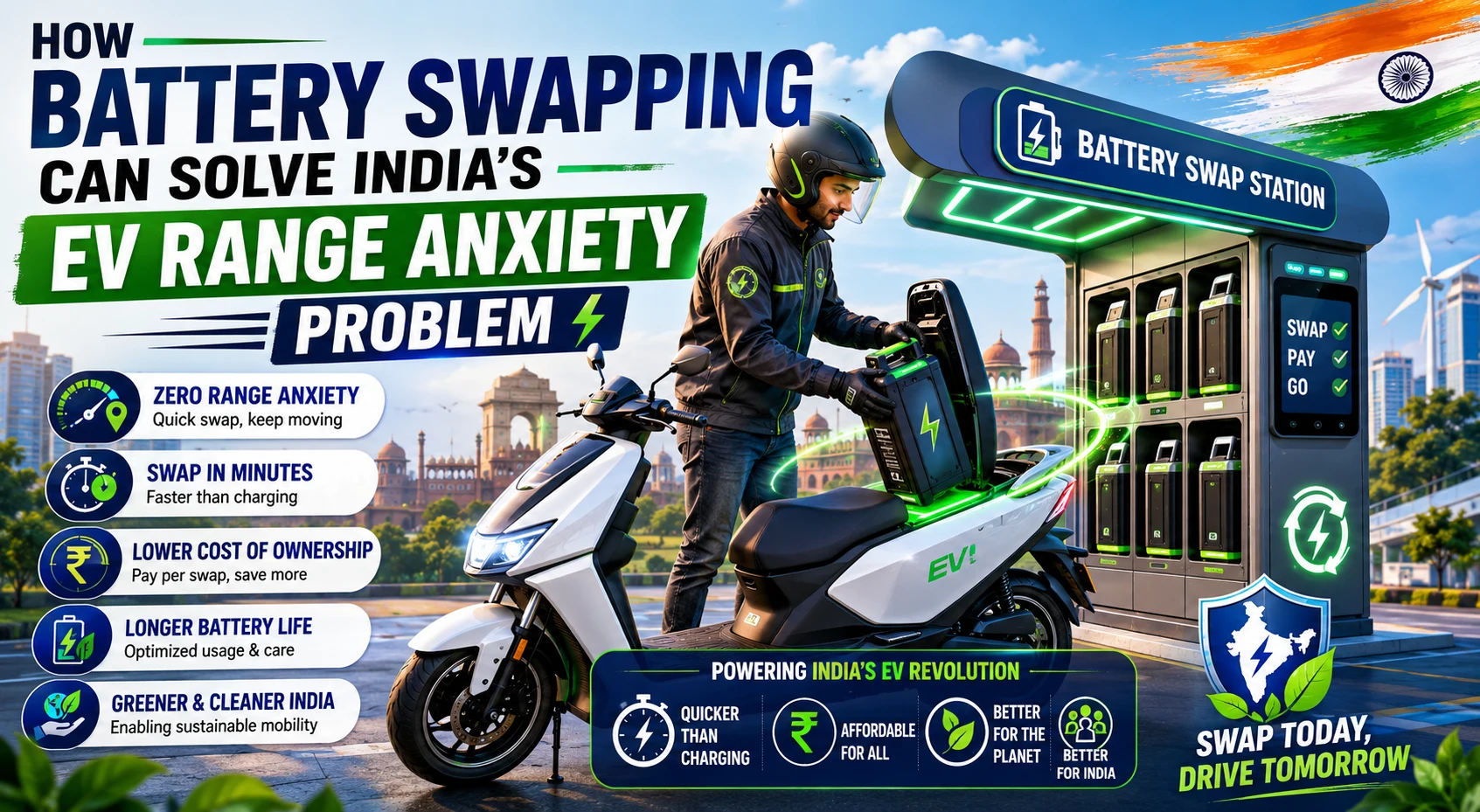
Battery swapping allows EV users to replace a depleted battery with a fully charged one at a designated swapping station instead of waiting for the battery to recharge.
The process is simple:
The vehicle arrives at a battery-swapping station.
The discharged battery is removed.
A fully charged battery is installed.
The user resumes the journey within minutes.
The entire process can take less than five minutes, offering a convenience level similar to traditional fuel refueling.
Why Battery Swapping Makes Sense for India
India's transportation ecosystem presents unique opportunities for battery-swapping solutions.
High Two-Wheeler and Three-Wheeler Usage
India is one of the world's largest markets for two-wheelers and three-wheelers. These vehicles typically operate on fixed routes and require frequent daily usage.
Battery swapping enables:
Faster turnaround times
Reduced downtime
Increased daily earnings
Improved operational efficiency
This makes swapping particularly attractive for delivery partners, e-rickshaw operators, and commercial fleet owners.
Urban Mobility Demands
Major cities such as Delhi, Mumbai, Bengaluru, Chennai, and Hyderabad face increasing transportation demands.
Battery-swapping networks can support:
Last-mile connectivity
Urban logistics
Shared mobility platforms
Electric taxi fleets
As urban populations continue to grow, swapping infrastructure can help meet mobility requirements more efficiently.
Eliminating Long Charging Wait Times
One of the biggest frustrations among EV users is charging time. Depending on battery size and charger type, charging can take anywhere from 30 minutes to several hours. For commercial operators, this downtime translates directly into lost revenue. Battery swapping virtually eliminates this challenge by providing immediate access to fully charged batteries.
Benefits include:
Increased vehicle utilization
Faster fleet operations
Reduced waiting times
Improved customer satisfaction
This convenience is a major reason why battery swapping is frequently highlighted at industry-leading EV Expo India events as a critical enabler of large-scale EV adoption.
Lowering the Cost of EV Ownership
Battery packs account for a significant portion of an EV's overall cost.
Battery-swapping models often separate battery ownership from vehicle ownership through Battery-as-a-Service (BaaS) programs.
Under this model:
Customers purchase the vehicle without the battery.
Batteries are rented or subscribed to.
Users pay only for battery usage.
Advantages include:
Lower upfront vehicle costs
Flexible payment options
Reduced maintenance concerns
Easier battery upgrades
This affordability can help make electric mobility accessible to a wider segment of India's population.
Supporting Commercial Fleets
Commercial fleets are among the strongest candidates for battery-swapping adoption.
Fleet operators prioritize:
Maximum uptime
Predictable operating costs
Faster turnaround
Efficient route management
Battery swapping addresses all these requirements while helping businesses transition toward cleaner transportation solutions.
Applications include:
E-commerce delivery vehicles
Food delivery fleets
E-rickshaws
Ride-hailing services
Urban logistics vehicles
Many fleet operators are already exploring battery-swapping partnerships to improve operational efficiency and reduce energy costs.
Enabling Faster EV Infrastructure Expansion
Building extensive charging networks requires significant investments in land, power infrastructure, and charging equipment.
Battery-swapping stations often require less space and can be deployed strategically in:
Fuel stations
Parking facilities
Commercial hubs
Logistics centers
Transit corridors
This flexibility allows infrastructure providers to expand EV support networks more rapidly.
As showcased at various Automotive Exhibition India platforms, battery-swapping ecosystems are becoming an important component of India's future mobility strategy.
Challenges That Need to Be Addressed
While battery swapping offers numerous benefits, several challenges must still be overcome.
Standardization
Different manufacturers use different battery sizes, designs, and specifications.
Industry-wide battery standardization is essential to:
Ensure compatibility
Improve scalability
Enhance user convenience
Investment Requirements
Developing nationwide swapping infrastructure requires substantial investment in:
Stations
Battery inventory
Software systems
Maintenance networks
Regulatory Framework
Clear government policies and industry standards are necessary to encourage wider adoption and investment. Collaborative efforts between policymakers and industry stakeholders will play a key role in addressing these challenges.
The Future of Battery Swapping in India
India's EV market is expected to experience significant growth over the coming years. As vehicle adoption increases, battery-swapping technology is likely to become an integral part of the mobility ecosystem.
Emerging innovations include:
AI-powered battery management
Smart battery tracking
IoT-enabled swapping stations
Automated battery replacement systems
Renewable energy integration
These advancements will further improve efficiency, reliability, and user experience.
Industry discussions at leading EV Expo India events continue to highlight battery swapping as one of the most practical solutions for overcoming range anxiety and supporting large-scale EV deployment.
Conclusion
Range anxiety remains one of the biggest barriers to widespread electric vehicle adoption in India. However, battery swapping offers a practical, scalable, and user-friendly solution that addresses many of the challenges associated with traditional charging systems.
By reducing charging times, lowering ownership costs, increasing vehicle uptime, and supporting commercial fleet operations, battery swapping has the potential to accelerate India's transition toward sustainable transportation.
As innovation continues across the electric mobility sector, platforms such as AutoTech Asia provide valuable opportunities for industry leaders to explore emerging technologies, share insights, and discover solutions shaping the future of transportation. The growing focus on battery swapping at every major Automotive Exhibition India and EV Expo India demonstrates its importance in building a more efficient and accessible electric mobility ecosystem.
Comments (8)


David Kim
2 days agoGreat article! I'm particularly interested in the battery swapping technology mentioned. Has anyone here had experience with Gogoro's system in Taiwan? I'm curious about the user experience compared to traditional charging.

About the Author
Ashok Kumar
EV Technology Specialist
Ashok Kumar specializes in electric vehicle technology and infrastructure development across Asia.
Related Articles

Subscribe to Our Newsletter
Get the latest automotive technology insights delivered directly to your inbox